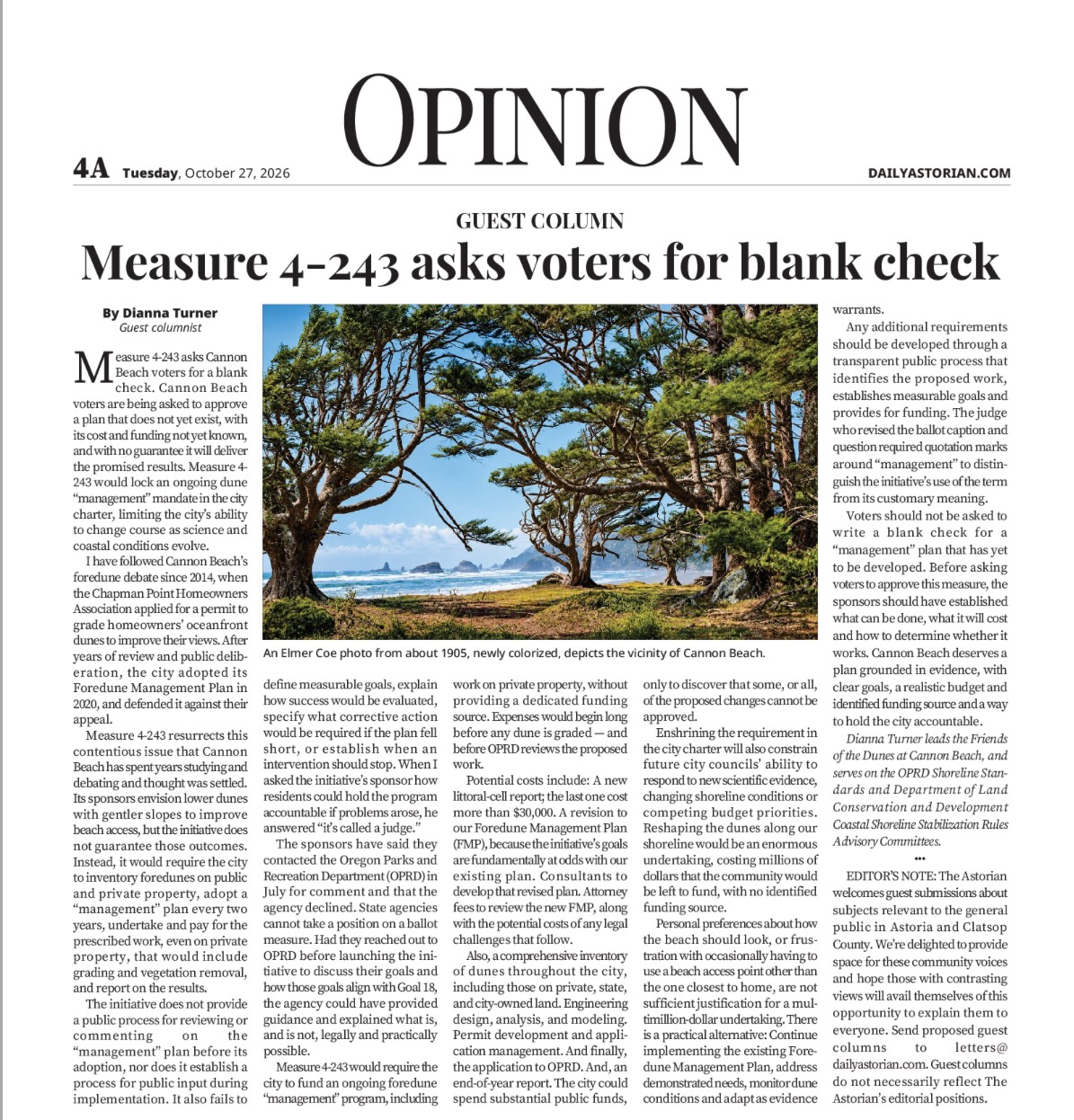
Measure 4-243 asks Cannon Beach voters for a blank check
Cannon Beach voters are being asked to approve a plan that does not yet exist, with its cost and funding not yet known, and with no guarantee it will deliver the promised results.
Measure 4-243 would lock an ongoing dune “management” mandate in the City Charter, limiting the City’s ability to change course as science and coastal conditions evolve.
I have followed Cannon Beach’s foredune debate since 2014, when the Chapman Point Homeowners Association applied for a permit to grade homeowners’ oceanfront dunes to improve their views. After years of review and public deliberation, the City adopted its Foredune Management Plan in 2020, and defended it against their appeal.
Measure 4-243 resurrects this contentious issue that Cannon Beach has spent years studying and debating and thought was settled. Its sponsors envision lower dunes with gentler slopes to improve beach access, but the initiative does not guarantee those outcomes. Instead, it would require the City to inventory foredunes on public and private property, adopt a “management” plan every two years, undertake and pay for the prescribed work, even on private property, that would include grading and vegetation removal, and report on the results.
The initiative does not provide a public process for reviewing or commenting on the “management” plan before its adoption, nor does it establish a process for public input during implementation. It also fails to define measurable goals, explain how success would be evaluated, specify what corrective action would be required if the plan fell short, or establish when an intervention should stop.
When I asked the initiative’s sponsor how residents could hold the program accountable if problems arose, he answered “it’s called a judge.”
The sponsors have said they contacted the Oregon Parks and Recreation Department (OPRD) in July for comment and that the agency declined. State agencies cannot take a position on a ballot measure. Had they reached out to OPRD before launching the initiative to discuss their goals and how those goals align with Goal 18, the agency could have provided guidance and explained what is and is not legally and practically possible.
Measure 4-243 would require the City to fund an ongoing foredune “management” program, including work on private property, without providing a dedicated funding source.
Expenses would begin long before any dune is graded—and before OPRD reviews the proposed work. Potential costs include:
A new littoral-cell report; the last one cost more than $30,000.
A revision to our Foredune Management Plan (FMP), because the initiative’s goals are fundamentally at odds with our existing plan.
Consultants to develop that revised plan.
Attorney fees to review the new FMP, along with the potential costs of any legal challenges that follow.
A comprehensive inventory of dunes throughout the city, including those on private, state, and city-owned land.
Engineering design, analysis, and modeling.
Permit development and application management.
And finally, the application to OPRD.
An end-of-year report.
The City could spend substantial public funds only to discover that some or all of the proposed changes cannot be approved.
Enshrining the requirement in the City Charter will also constrain future City Councils’ ability to respond to new scientific evidence, changing shoreline conditions or competing budget priorities.
Reshaping the dunes along our shoreline would be an enormous undertaking, costing millions of dollars that the community would be left to fund with no identified funding source. Personal preferences about how the beach should look, or frustration with occasionally having to use a beach access point other than the one closest to home, are not sufficient justification for a multimillion-dollar undertaking.
There is a practical alternative: continue implementing the existing Foredune Management Plan, address demonstrated needs, monitor dune conditions and adapt as evidence warrants. Any additional requirements should be developed through a transparent public process that identifies the proposed work, establishes measurable goals and provides for funding.
The judge who revised the ballot caption and question required quotation marks around “management” to distinguish the initiative’s use of the term from its customary meaning.
Voters should not be asked to write a blank check for a “management” plan that has yet to be developed. Before asking voters to approve this measure, the sponsors should have established what can be done, what it will cost and how to determine whether it works. Cannon Beach deserves a plan grounded in evidence, with clear goals, a realistic budget and identified funding source and a way to hold the City accountable.
Dianna Turner
Dianna Turner leads the Friends of the Dunes at Cannon Beach, and serves on the OPRD Shoreline Standards and DLCD Coastal Shoreline Stabilization Rules Advisory Committees.
Published in The Astorian on Tuesday October 27, 2026
Paid for by Friends of the Dunes at Cannon Beach - No o 4-243