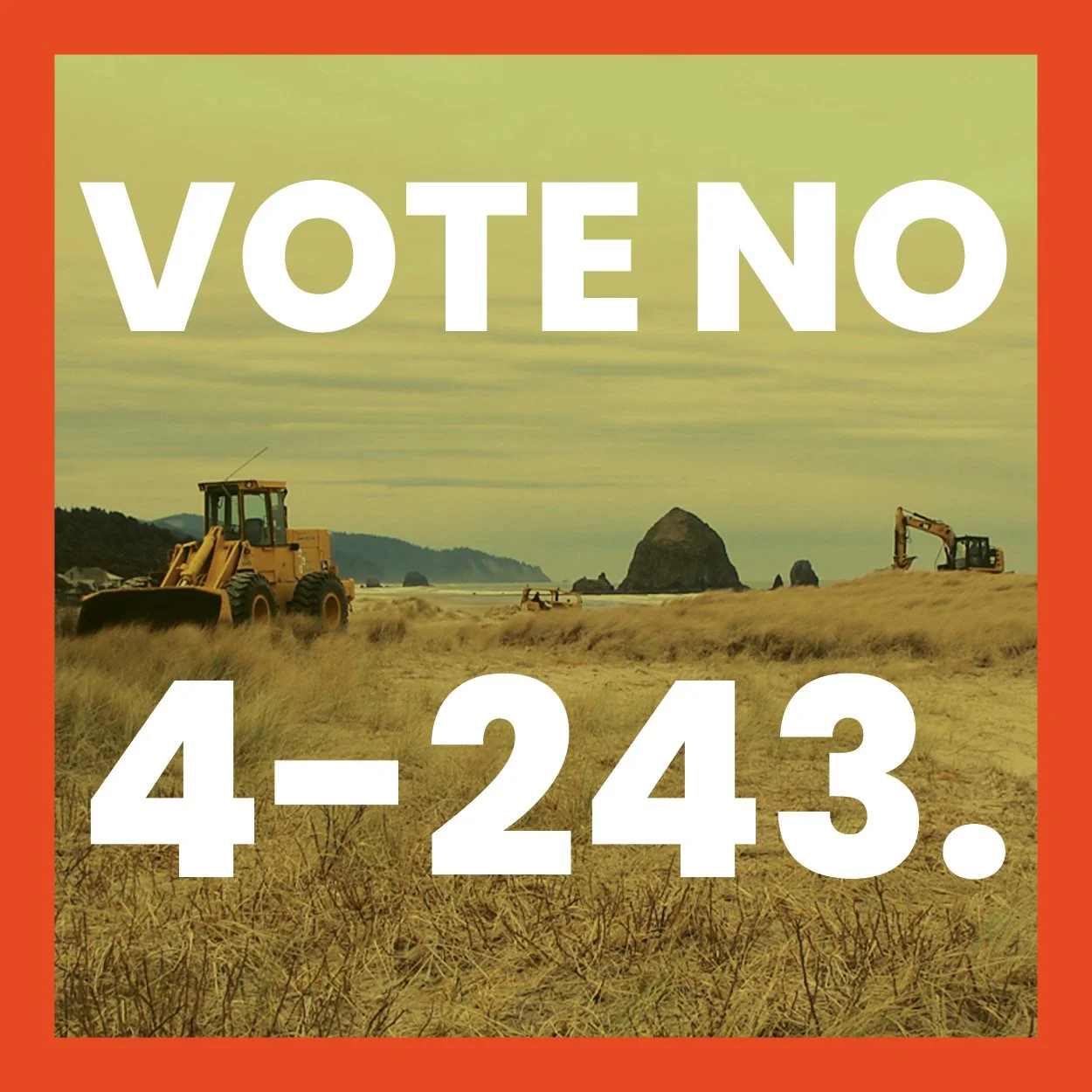
DON’T BE FOOLED
New Name. Same Goal:Dune Grading
The debate over dune grading did not begin with Measure 4-243.
The current debate has its roots in a 2014 application by the Chapman Point Homeowners Association (HOA) to grade its oceanfront foredunes to improve their ocean views from inside.
What followed was a lengthy public process involving scientists, land-use policy experts, multiple state agencies, Planning Commission review and numerous contentious community meetings and City Council deliberation.
In 2019, the City ultimately ended dune grading for views.
The current 2020 Foredune Management Plan, while eliminating grading for views, continues to allow limited grading for purposes such as maintaining public access, remedial grading and addressing certain hazards.
The Chapman Point and Breakers Point HOAs appealed that decision to the Oregon Land Use Board of Appeals (LUBA). In 2021, LUBA rejected the HOAs’ arguments—including arguments we are hearing today concerning the effects of European beach grass, safety, and access—and upheld the City’s decision.
Today’s Initiative, a Solution in Search of a Problem
The current initiative does not mention ocean views. But many of the same proposals and arguments remain: foredune grading, removal of European beach grass, and claims involving “safety,” “access,” “hazards,” “sustainability,” “beautification,” and razor clams.
The language and campaign slogans may be somewhat different, but the proposed physical changes to the foredunes are strikingly similar to those at issue before.
This is a continuation of the long-running debate over whether and how the established foredunes that protect our town should be physically altered in ways that would benefit primarily oceanfront properties.
There is, however, a significant difference this time. The initiative would shift responsibility for the work—and the expense and risk—of dune grading and foredune “management” to the City and, ultimately, its taxpayers.
Follow the Money: Connections to the Earlier Campaign
There is also a documented financial connection between the current campaign and some of the property owners and organizations involved in the earlier dispute.
Oregon campaign-finance records reveal every donor, except one, owns oceanfront property, and only a couple are full-time residents. This is not a community mandate. It is funded by those who benefit most from dune grading.
According to those finance records, Breakers Point HOA contributed $2,000 to the campaign. Several individual property owners within the Chapman Point HOA have also contributed. (See who funds Measure 4-243.)
These contributions provide a documented link between some supporters of the current initiative and the homeowners and organizations involved in the earlier effort to allow foredune grading for views.
The donations do not, by themselves, establish the motives of every person who supports the initiative. But they are relevant when considering the history of the proposal, the interests involved, and the connections between the current campaign and the initiative's proponents’ long-held goals.
An Unfunded Mandate With an Unknown Price Tag
Another important consideration is that the proposal creates an unfunded mandate: voters are being asked to approve an ongoing requirement now, while the actual plan for implementing it has not yet been developed and its eventual cost is unknown.
Supporters have argued that the lack of dedicated funding is not a concern because the City currently has approximately $15 million in additional funds available. But those funds exist today; the plan voters are being asked to approve does not.
Until the details of that plan are developed, there is no way to know what the program will actually cost, what portion of the City’s available funds may ultimately be required, or what the costs might look like in future years.
A surplus today does not permanently fund a financial obligation placed in the City Charter. What happens when there is no longer a surplus?
The financial question, therefore, is not simply whether the City can afford to begin this work today. The question is how the City will sustainably fund an ongoing obligation for years to come—and what other City priorities may compete for those same resources.
Just as importantly, the proposal does not establish a clear mechanism for evaluating whether the eventual plan is successful. Nor does it outline a process for residents to raise concerns, seek changes, or challenge aspects of the program if they are dissatisfied with how it is ultimately implemented.
We are being asked to sign a blank check for a program that has not yet been designed, whose costs are unknown, whose long-term funding is uncertain, and for which there is no clear process for measuring success or addressing problems once it is in place.
Why would anyone agree to that?
Shackling the City to an Outdated Approach
This initiative would lock the City into a management approach that is at odds with contemporary coastal science and natural-resource management best practices. The scientific and resource-management community recognizes that healthy foredunes are dynamic systems—systems that build, migrate, absorb storms and carbon, and respond naturally to wind, waves, vegetation, and changing conditions. Now, the emphasis is on working with these natural processes rather than repeatedly grading, clearing, and reshaping dunes.
The proponents’ own video highlights the Shoreline Management Education City Council Work Session with Dr. Peter Ruggiero, Jessica Cote, and Meg Reed. But listen to what the experts actually said — they emphasized the importance of working with nature rather than trying to over-engineer it.
That distinction matters. This initiative would move Cannon Beach in the opposite direction, in conflict with our Foredune Management Plan and the State's directives. It would establish a continuing program of physical intervention in the foredunes and place that policy in the City Charter, even as coastal management increasingly emphasizes natural processes, monitoring, and adaptation.
We cannot know what coastal conditions—or our understanding of them—will look like 10, 20, or 50 years from now. What we can do is preserve the City’s ability to respond to new evidence. A changing shoreline requires adaptive management, not a permanent mandate for intervention.
A Better Path for Cannon Beach
The choice is not between managing our dunes and doing nothing. The choice is between adaptive management based on demonstrated need and a charter-mandated program of ongoing intervention.
Cannon Beach’s current Foredune Management Plan recognizes that the foredune is a dynamic system. It provides for maintaining adequate sand volume and dune strength, protecting public access and infrastructure where necessary, and intervening when there is a demonstrated need. Just as importantly, it provides a framework for monitoring, evaluating, and adapting management as conditions and scientific understanding evolve.
The proposed initiative takes a fundamentally different approach. It would require the City to inventory foredunes on both public and private property, adopt a management plan every two years, and undertake grading and/or revegetation at City expense. That is not simply preserving the option to act when a genuine problem arises. It creates an ongoing obligation to intervene.
Working with nature means intervening when the evidence demonstrates a need—not assuming that dunes must continually be altered because they are tall, steep, grassy, or inconvenient. Our current plan already provides tools to address legitimate concerns involving access, erosion, flooding, and other hazards while preserving the flexibility to change course as conditions and knowledge evolve.
Let the City respond to actual conditions. Let science guide the work. Let the dunes do what dunes naturally do. And when intervention is truly necessary, let the City act carefully, transparently, and based on the best available evidence.
That is adaptive management—and a more responsible legacy for Cannon Beach than placing a potentially outdated management mandate in the City Charter. We should not require tomorrow's leaders to defend yesterday's assumptions when better evidence may call for a different approach.
Want to dig deeper? Here are the facts:
PAC Video: cannonbeachdunes.com
Ballot Initiative: https://cannonbeachdunes.com/initiative/
Foredune Management Plan (FMP): https://www.ci.cannon-beach.or.us/media/18291
Shoreline Management Education Presentation 7/15/25: https://www.youtube.com/live/sDrQkwVgU2Y
Oregon State Goal 18: https://www.ci.cannon-beach.or.us/media/14151
KMUN article regarding initiative and Fire District Board Resignations: https://kmun.org/group-pushes-for-dune-management-on-november-ballot
Dr. Sally Hacker's Beachgrass 9/11/19 FMP Presentation: https://www.ci.cannon-beach.or.us/media/14161
Fire District Comments Regarding Safety/Access: Download PDF document.
March 2026 Fire District Minutes (highlights added): Fire District March 2026 Minutes
CB Fire Dept. Emails: https://drive.google.com/file/d/1TsG4zA6jZckq68lCFuJKVTrLeLT4xziL/view?usp=sharing
PAC's financial donors: https://secure.sos.state.or.us/orestar/cneSearch.do?cneSearchButtonName=search&cneSearchFilerCommitteeId=24610&OWASP_CSRFTOKEN=FCFY-5YM3-7R1X-34A4-GFJF-LXIM-LPP0-JZQY
Lifeguard John Rippey's Testimony: https://drive.google.com/file/d/1bnHI3hZtBqTVFmHNsR703DqpmMKzJFou/view?usp=sharing
Chapman Point HOA meeting: https://chapmanpoint.yolasite.com/resources/2015%20Minutes,%20CPHOA%20AGM.pdf
Paid for by Friends of the Dunes at Cannon Beach - No on 4-243